
Office Movers Near Me: Compare Scope and Quotes
Compare office movers near Windsor by service scope, cost drivers, access, continuity, and written quote details before booking with confidence in Ontario.

For an office move in Windsor, choose a commercial mover that clearly defines the scope, crew, equipment, access plan, protection, and setup work in writing. Office-moving costs depend on inventory, distance, access, packing, storage, timing, and special handling, so send those details before comparing at least three written estimates.
Find Office Movers Near You in Windsor and Essex County
Businesses searching for office movers near them usually need more than a truck and labour. They need a provider that can coordinate furniture, equipment, building access, packing, transport, unloading, and the handoff to a usable workspace.
EC Movers Ltd provides commercial and office moving support in Windsor and Essex County, including LaSalle. When comparing local office movers, verify that you are dealing with the moving company itself, not only a broker passing the work to another crew.
Check the provider’s local presence, references, protection methods, insurance details, and written scope. The federal Office of Consumer Affairs recommends these checks and advises consumers to distinguish a mover from a broker. Federal moving advice provides a useful checklist.
Ontario moving companies are not provincially licensed, so a licence alone is not a useful comparison point. Written terms, insurance, references, clear responsibilities, and a realistic access plan matter more when selecting a commercial mover. Related reading: Moving Cost Estimator: How to Build a Realistic Moving Budget in Ontario.
Choose the Office-Moving Service Scope That Fits Your Business
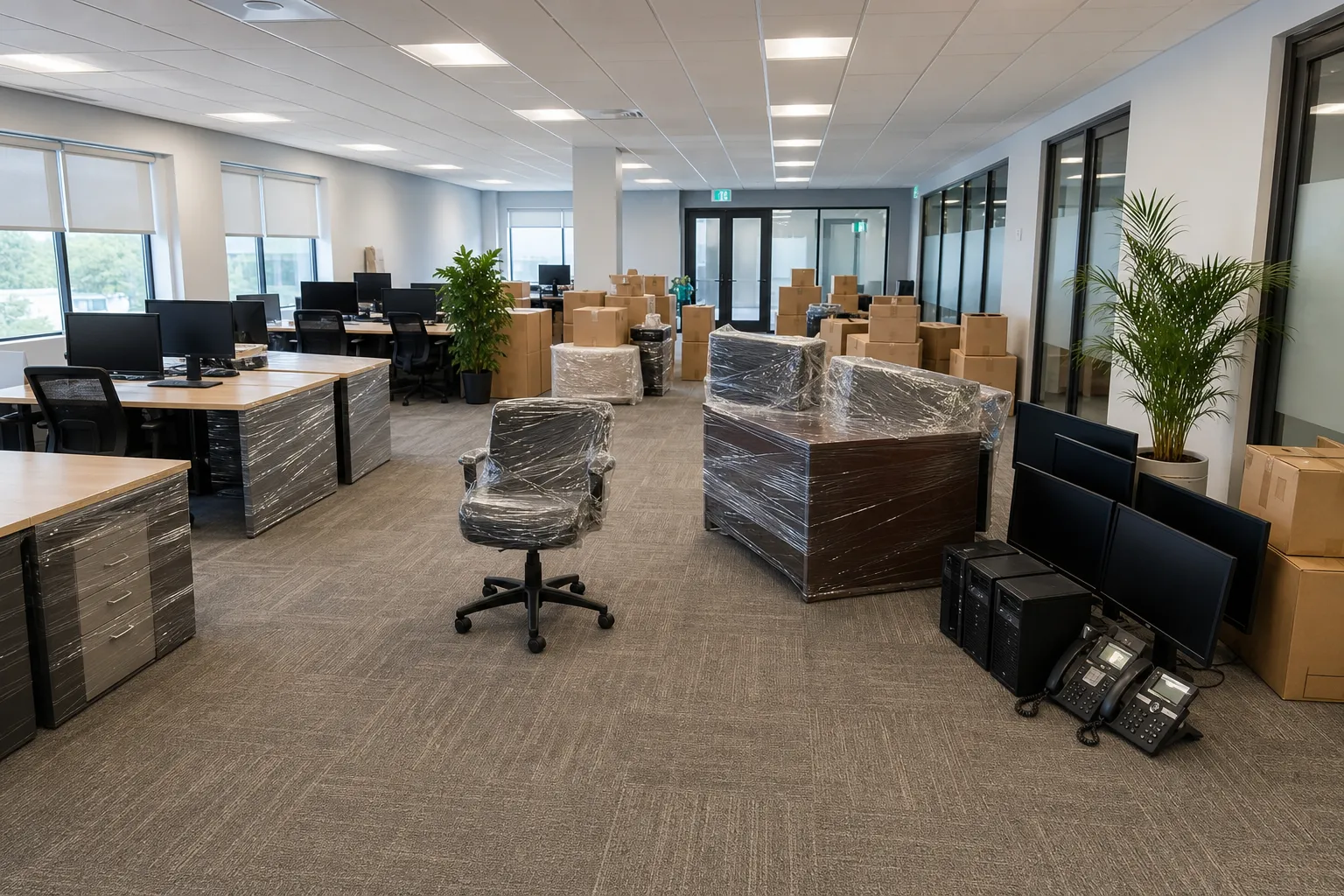
The right service level depends on how much work your team can handle and how much disruption the business can absorb. A small office with easy ground-floor access may need loading, transport, and unloading, while a multi-floor relocation may require packing, furniture disassembly, labelling, reassembly, storage, and staged delivery.
| Office situation | Service scope to consider | What to confirm |
|---|---|---|
| Small office with packed boxes and straightforward access | Loading, transport, and unloading | Truck access, parking, crew size, arrival window, and protection for furniture and floors |
| Office with desks, shelving, or filing cabinets | Furniture disassembly and reassembly alongside moving labour | Which items will be taken apart, labelled, rebuilt, and placed at the destination |
| Packing-heavy relocation | Partial or full packing, materials, labelling, loading, and setup | Who packs electronics, files, fragile items, and workstations |
| Multi-floor or multi-tenant office | Full relocation coordination with access planning | Elevator bookings, loading zones, stairs, building rules, floor protection, and delivery sequence |
| Phased relocation | Planned loading and delivery in stages | Which departments move first, where essential equipment goes, and how each phase will be signed off |
| Closing dates or construction delays | Moving with short-term storage coordination | Storage duration, pickup and redelivery responsibilities, and handling charges |
A porter-style service generally focuses on carrying and loading. Packers add preparation, materials, labelling, and sometimes unpacking. For an office, the better choice is the service that covers the tasks your staff cannot complete without delaying normal work.
EC Movers describes a broader workflow that can include packing, loading, transportation, unloading, furniture assembly, new-space setup, and short-term storage coordination. Its office relocation workflow shows how preparation, transport, unloading, and setup connect.
Do not assume that a moving crew will shut down servers, disconnect network equipment, configure workstations, perform electrical work, or manage confidential-record compliance. Assign those responsibilities to your staff or specialist providers unless the written moving scope expressly includes them.
What Drives the Cost of an Office Move?
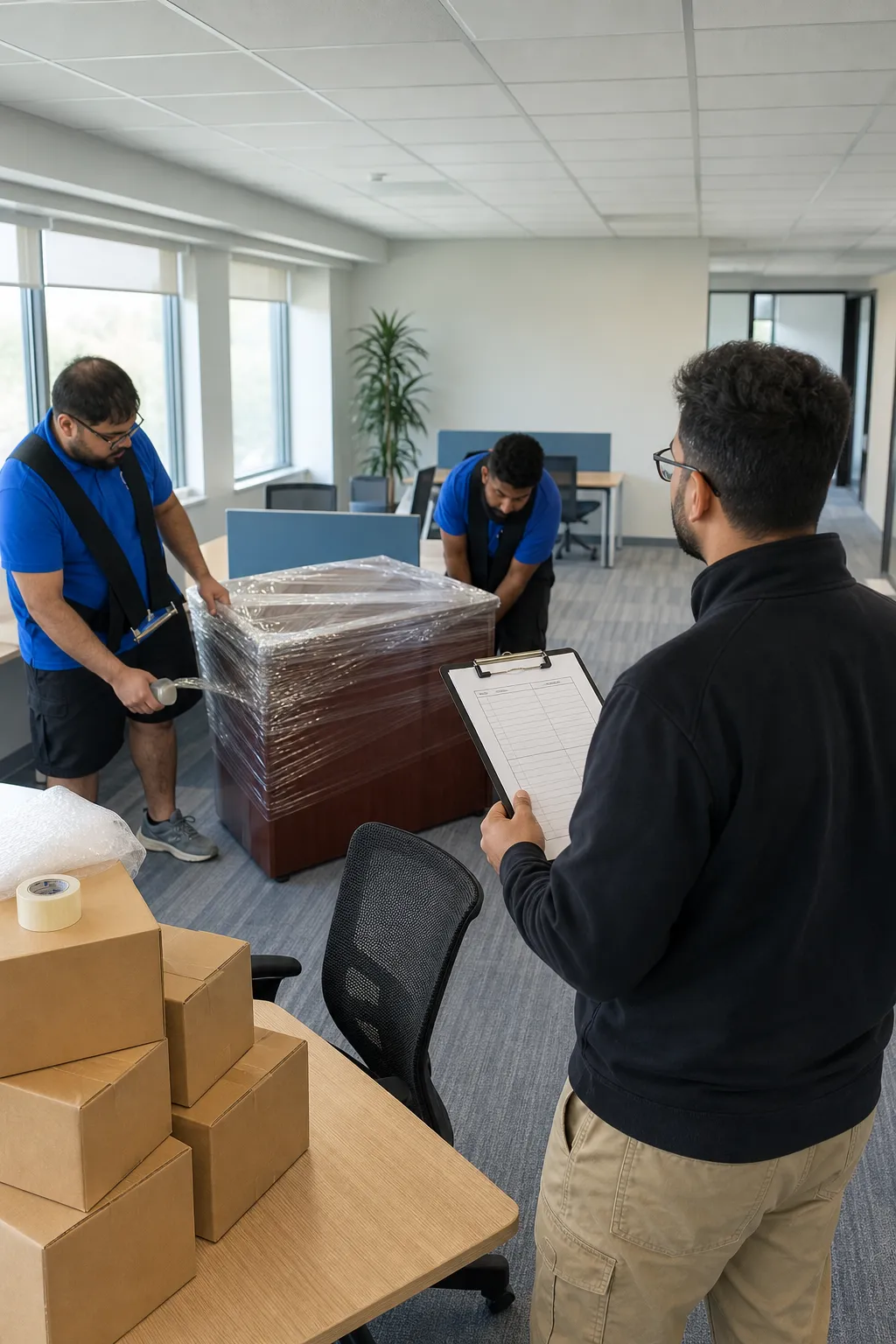
The largest cost pressure in an office move usually comes from labour-intensive scope, difficult access, high inventory volume, or added services. Distance matters, but it is only one part of the estimate.
- Inventory volume and weight: Desks, cabinets, shelving, printers, records, and equipment affect truck space and crew effort.
- Office size and layout: Dense workstations take longer to clear than lightly furnished space.
- Access: Stairs, corridors, narrow doors, loading docks, elevators, and restricted parking change the work involved.
- Packing and materials: Full packing requires more labour than moving ready-to-load boxes.
- Disassembly and reassembly: Workstations, shelving, and conference tables add preparation and setup time.
- Storage: Temporary storage introduces handling, duration, access, and redelivery considerations.
- Timing: Narrow building windows, phased moves, or weekend schedules affect planning and availability.
- Special handling: Safes, oversized furniture, sensitive equipment, or difficult routes require advance assessment.
Ontario’s commercial-relocation rules recognise office furniture, equipment, stock-in-trade, computers, and electronic devices as relevant goods in this context. An office quote should therefore describe the inventory and handling responsibilities in practical terms, not simply state “commercial move.” Ontario Regulation 643/05 sets out the relevant definitions.
Illustrative example: A small ground-floor office with packed boxes, nearby parking, and no disassembly will generally require less labour than a larger multi-floor office with elevator bookings, full packing, furniture reassembly, and temporary storage. This explains why similar travel distances can produce very different estimates. It is not a price quote.
There is no universal answer to “What is the most expensive part of moving?” For an office, full packing, large inventory, difficult access, disassembly, storage handling, and special equipment are common cost drivers.
Request an Office-Moving Quote That Can Be Compared
Send the same information to every provider so the estimates describe the same move. A short video walkthrough, floor plans, photographs of access points, and approximate item counts are more useful than a general description such as “one small office.”
- Origin and destination addresses, floor numbers, and building names
- Preferred dates, deadlines, access windows, and whether phasing is possible
- Room-by-room inventory with quantities and unusually heavy or fragile items
- Photos or plans showing entrances, stairs, elevators, loading areas, and parking restrictions
- Packing requirements, materials, labelling, and unpacking expectations
- Furniture disassembly, reassembly, workstation placement, and setup requirements
- Storage needs, duration, priority equipment, and items not moving
- Building rules, required insurance documents, and the main on-site contact
- Responsibilities for computers, servers, networks, confidential files, and final testing
Ask the mover to state the crew size, vehicle plan, arrival window, estimated duration, protection methods, included services, exclusions, deposit, payment terms, and process for scope changes. These office moving quote questions help turn a broad estimate into a comparable plan.
Compare Office Moving Quotes by Scope, Not Headline Price

Ontario recommends obtaining at least three written estimates and clearly stating what each includes. For contracts over $50, terms must be written and include the mover’s contact information, service description, itemized prices, total amount, dates, and payment terms. Ontario’s hiring-a-mover guidance explains these requirements.
| Quote item | What to compare |
|---|---|
| Scope | Loading, transport, unloading, packing, unpacking, disassembly, reassembly, setup, and storage |
| Crew and vehicle | Number of movers, vehicle capacity, equipment, and supervision |
| Schedule | Move date, arrival window, access window, stages, and delivery sequence |
| Access | Stairs, elevators, loading zones, parking, long carries, and building restrictions |
| Protection and liability | Insurance, protection methods, damage responsibility, claims process, and exclusions |
| Packing and materials | Boxes, wraps, reusable containers, labelling, fragile-item handling, and disposal |
| Storage | Duration, handling, access, pickup, redelivery, and changing-date charges |
| Payment terms | Deposit, balance, payment methods, cancellation, and scope changes |
The cheapest way to move business property across Canada is not necessarily the quote with the lowest starting number. A lower estimate can exclude packing, difficult access, storage, assembly, protection, or additional handling. Compare the complete scope and responsibilities.
A professional-looking website or high review count is not enough by itself. Check the company’s identity, local presence, references, insurance, written terms, and whether it is the actual provider. Record verbal answers in an email or revised estimate.
Office Moving Questions Windsor Businesses Should Ask
How far in advance should I book office movers in Windsor?
Start as soon as you know the target date, especially if the move involves building permissions, elevator bookings, multiple floors, packing, storage, or a narrow closing window. Four or more weeks gives you time to build the inventory, obtain estimates, and resolve access issues.
Can office movers work in phases or outside regular business hours?
Some moves can be staged or scheduled outside normal business hours, but availability depends on the crew, building rules, access permissions, and agreed schedule. Ask for each phase, arrival window, access requirement, and additional charge to be written into the estimate.
What information should I provide for an accurate office-moving quote?
Provide both addresses, floor numbers, inventory counts, photographs or floor plans, stairs and elevator details, parking restrictions, packing and assembly needs, storage requirements, preferred dates, priority equipment, and building rules.
Do office movers move computers, servers, and confidential records?
Movers may transport furniture and equipment when those items are included in the scope. Responsibility for shutdown, backup, disconnection, network configuration, reconnection, testing, and confidential-record controls must be assigned clearly.
What is usually the most expensive part of an office move?
Labour-intensive work is often the strongest cost driver, including full packing, large inventory, difficult stairs or elevators, long carries, furniture disassembly, storage handling, tight access windows, and special equipment.
Prepare your inventory, access details, preferred dates, packing needs, storage requirements, and continuity plan before requesting estimates. For a Windsor-area relocation, ask EC Movers Ltd to review that information through its commercial and office moving service before booking.
Ready to move?
Get your free quote from EC Movers today.