
Piano Transport Equipment Compared: What DIY Moves Require and When to Hire Professionals
Compare piano transport equipment for upright and grand pianos, assess your route, and decide when DIY handling is unsuitable or professional help is wiser.
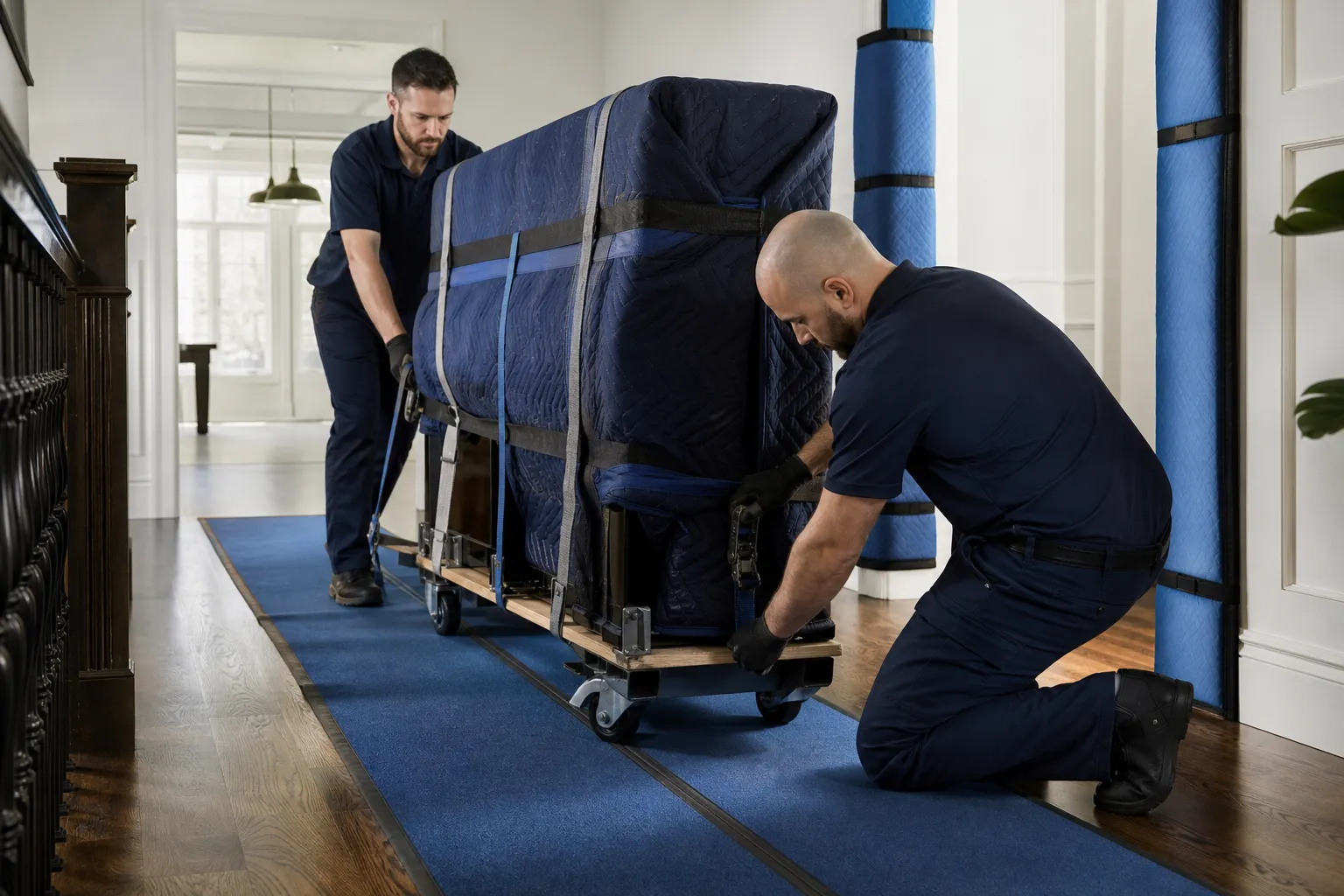
Piano transport equipment can support a controlled move, but equipment alone does not make moving a piano safe. The right choice depends on the piano type, the narrowest part of the route, the available helpers, and how the instrument will be secured for transport.
Uprights and grand pianos require different support methods. A suitable piano dolly may help with an upright on a straightforward route, while a grand may require a piano board or skid board, careful preparation, and more involved handling. Stairs, tight turns, uneven access, and uncertain clearances are strong reasons to use trained piano movers instead of treating the move as ordinary furniture transport.
Quick summary
- Upright pianos commonly require a high-capacity piano dolly, protective padding, straps, floor protection, and a measured route.
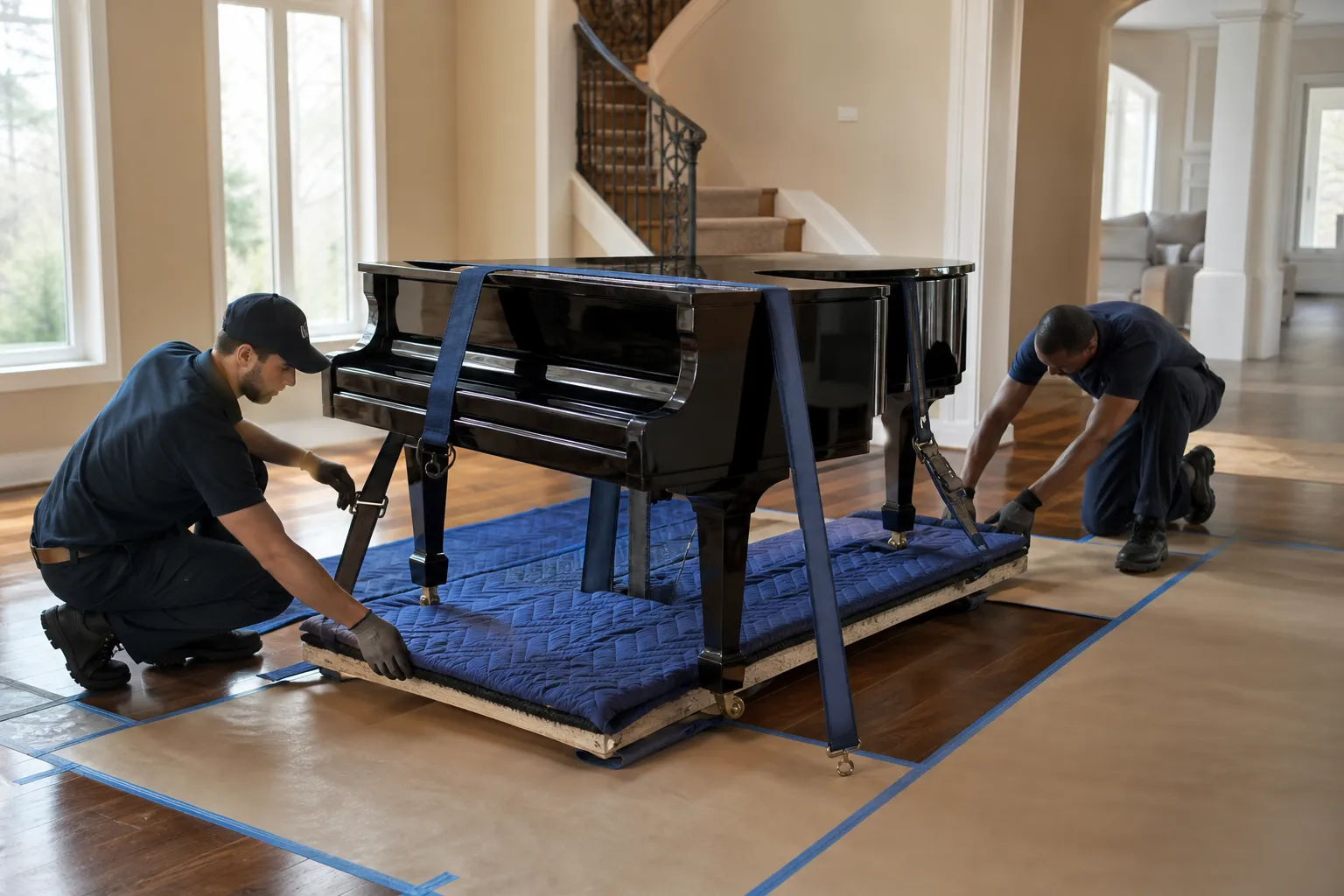
- Grand pianos may require a piano board or skid board, component preparation, secure strapping, and more specialised coordination.
- A regular household furniture dolly is not a safe substitute for equipment suited to a piano’s concentrated load and shape.
- Stairs, tight turns, narrow landings, difficult vehicle access, or insufficient trained helpers usually favour professional handling.
Equipment changes with the piano type
A piano is not simply a heavy cabinet. Its weight is unevenly distributed, its finish and internal components are vulnerable to contact and sudden movement, and its dimensions can make a route difficult even when the total distance is short. Equipment must support both the instrument and the people controlling it.
An upright generally remains vertical, while a grand may need to be prepared and supported on its side using a piano board or skid board. The correct equipment depends on the instrument, but also on stairs, thresholds, turns, floor surfaces, doorways, and the loading method.
Upright piano moving equipment

For a straightforward upright move, the central item is usually a high-capacity piano dolly suited to the load and configured for stability. The dolly is only one part of the system. Blankets, protective sleeves, straps, corner protection, floor runners, and a clear path help limit uncontrolled contact with walls, flooring, and door frames.
- A high-capacity piano dolly appropriate for the piano and route.
- Heavy-duty moving blankets and stretch wrap for the casework.
- Ratchet straps with protective sleeves to secure wrapping without pressing directly against the finish.
- Lifting straps where they suit the planned handling method.
- Corner guards, foam, or towels for edges, pedals, and nearby property.
- Floor runners, threshold protection, and suitable ramp or stair equipment where required.
Do not assume that a dolly solves every problem. A piano can still shift, catch on a threshold, damage a floor, or become difficult to control around a sharp turn. Equipment must be rated and configured for the load, and the people using it must understand how to coordinate each movement.
Grand piano moving equipment
Grand piano moving equipment usually involves more preparation because the instrument has a wide body, projecting legs, and components that can be vulnerable during handling. A piano board, also called a skid board, can provide a more controlled support surface when the grand is prepared for movement. Removable parts should only be handled according to a planned method that protects the instrument and keeps components organised.
The equipment may include a piano board or skid board, padded blankets, protective sleeves, ratchet straps, lifting straps, corner protection, and floor runners. The board and straps must work together to keep the piano stable. The goal is not simply to lift the instrument, but to control its position through every turn, threshold, ramp, and loading transition.
Grand piano moves are especially unsuitable for improvised equipment. Before choosing a DIY approach, consider whether the full route has been measured, every helper understands the plan, and the vehicle can accept and secure the prepared piano without a last-minute change.
Match the equipment to each stage of the move
Separate piano transport equipment into three stages: preparation and protection, movement through the property, and vehicle loading and securing. This avoids assuming that blankets and a dolly cover every risk.
Preparation and protection equipment
Moving blankets cover the case, while stretch wrap can hold blankets in place when used carefully. Corner guards, foam, or towels can protect edges, pedals, and nearby walls. Painters tape may help secure a fallboard or lid over padding, but it should not be applied carelessly to a finished surface.
Floor runners, neoprene runners, or other suitable protection help create a safer path. Door frames, railings, corners, and elevator surfaces may also need padding. Basic tools can help with removing a bench or suitable components, but disassembly should be planned rather than improvised.
Movement equipment for dollies, boards, stairs, and thresholds
A piano dolly supports and rolls a piano in a controlled position. A piano board or skid board provides a different kind of support, particularly for a grand piano prepared for movement on its side. Neither removes the need for coordinated lifting, spotters, controlled speed, and a clear stop signal.
Ratchet straps help secure blankets and hold the piano to a dolly or board when used with protective sleeves. Lifting straps may help share the load, while ramps, stair equipment, and additional spotters may be needed for changes in level. Household straps, light-duty dollies, or equipment with unknown suitability should not be treated as interchangeable with purpose-suited piano equipment.
Vehicle loading and securing equipment
Getting a piano to the vehicle is only half of the task. It must be loaded without a sudden drop or uncontrolled shift, positioned securely, padded where contact could occur, and restrained for the journey. Strap tension should be checked after loading and rechecked during transit as appropriate.
The vehicle, loading surface, ramp arrangement, and anchor points all affect the plan. Vehicle access should therefore be assessed before moving the piano out of the building.
Route assessment checklist before choosing equipment
The narrowest, steepest, or most awkward part of the route controls the equipment decision. Measure the piano and assess the complete path, not only the front door and destination room.
- Measure the piano’s height, width, depth, and projecting parts.
- Measure doorways, hallways, elevator openings, stairs, landings, and tight turns.
- Identify thresholds, steps, ramps, uneven surfaces, overhead obstructions, and low clearances.
- Check door swings, railings, light fixtures, and furniture that restrict the route.
- Assess floor surfaces and plan runners, padding, or additional protection.
- Confirm vehicle access, parking distance, and whether the loading path is level and clear.
- Plan staging areas where the piano or equipment can be paused safely.
- Assign a lead person, lifters, spotters, and an equipment manager.
- Agree on a stop command so anyone can pause and reset the plan.
A route that cannot be measured confidently should not be treated as a routine DIY move. The equipment decision is only as reliable as the information behind it.
DIY equipment versus trained piano movers
The choice is not simply between renting equipment and paying for a service. It is a comparison between taking responsibility for route planning, coordination, protection, loading, and risk management yourself, or assigning those tasks to a trained crew with specialist equipment.
| Decision criterion | DIY handling | Trained piano movers |
|---|---|---|
| Route complexity | Best limited to a fully measured, straightforward route. | Better suited to stairs, tight turns, awkward landings, and difficult loading. |
| Equipment | You must identify, inspect, and configure suitable gear. | The crew selects equipment for the piano and route. |
| Coordination | Helpers must understand roles, commands, grips, and stop procedures. | The crew provides an organised handling process. |
| Protection | You plan floor, doorway, case, pedal, and corner protection. | Protection planning is incorporated into the service. |
| Liability | You must understand your responsibilities and coverage limitations. | Ask the provider to explain insurance, procedures, and inclusions. |
When the route includes stairs, tight turns, or unusual access points, a piano moving service can assess the space and bring appropriately rated equipment. Ask how the crew handles the piano type, what protection is used, how the piano will be secured, and what happens if actual conditions differ from the assessment.
When hiring professionals is the safer choice
Professional handling is usually more appropriate when the route includes stairs, narrow landings, sharp turns, uneven surfaces, or a difficult transition to the vehicle. It is also worth choosing trained movers when the piano is a grand, the finish is particularly valuable, the piano cannot be fully measured, or there are not enough coordinated helpers.
Before booking, ask:
- What equipment will be used for this piano type and route?
- Will the crew use a piano dolly, piano board or skid board, straps, floor protection, or stair equipment?
- How will the piano be wrapped, loaded, and secured?
- Does the quote include suitable disassembly and reassembly?
- Is the operation fully insured, and does it have WSIB certification?
- Is pricing provided upfront, and what could change the quote?
A provider that cannot explain the equipment and handling plan has not given you enough information to compare confidently. The relevant question is not whether a crew owns a dolly, but whether it can use the right equipment in a coordinated plan.
A final equipment and safety decision checklist
- Identify whether the piano is an upright or grand.
- Measure the instrument and every critical clearance.
- Choose equipment suited to the piano and route, not generic supplies.
- Plan protection for the piano, floors, doorways, railings, and corners.
- Assign roles and establish a clear stop command.
- Confirm how the piano will be loaded, padded, and secured.
- Arrange trained help if any critical measurement, equipment choice, or loading step remains uncertain.
For another perspective on the information a piano-moving checklist should cover, see this piano moving checklist. Preparation should cover the route, equipment, protection, coordination, and final securing, not just one item such as a dolly.
Frequently asked questions
Can I use a regular furniture dolly to move an upright piano?
A regular furniture dolly should not automatically be considered suitable. Upright pianos create a concentrated, uneven load, so the dolly must be appropriate for the piano and configured for stability. If the equipment rating, route, or handling method is uncertain, do not substitute household equipment.
What equipment is needed to move a grand piano?
A grand may require a piano board or skid board, protective blankets, ratchet straps with protective sleeves, lifting straps, corner protection, and floor runners. The exact equipment depends on the piano and route, so a generic checklist cannot replace an assessment.
What changes when a piano must be moved up or down stairs?
Stairs add changes in level, restricted footing, shifting weight, and limited options for correcting a mistake. The plan may require stair equipment, ramps, extra spotters, and carefully coordinated commands. Stairs are a strong reason to hire trained piano movers.
Are household moving blankets and straps enough for a piano move?
No. Blankets and straps provide protection and restraint, but they do not solve route planning, lifting, stability, equipment selection, or vehicle loading. They should be part of a complete handling plan.
Choose equipment based on the route, not just the piano
The best piano transport equipment matches the instrument, route, people handling it, and vehicle securing plan. A straightforward upright move may suit a suitable piano dolly and careful preparation, while a grand, staircase, tight turn, or uncertain clearance can change the decision quickly.
When the route or equipment is uncertain, professional handling is the more controlled option. EC Movers Ltd provides piano moving for grand pianos and uprights across Windsor and Essex County, with trained crews, specialist equipment, full liability insurance, and WSIB certification.
Ready to move?
Get your free quote from EC Movers today.