
10 Packing Supplies for Moving: Save Time and Stay Organized
A complete guide to packing materials for moving—boxes, wraps, pads, tape, and labels—plus pro tips from EC Movers for faster, safer Roseland moves.

Packing materials for moving are protective supplies—boxes, cushioning, wraps, and labels—that safeguard belongings and speed up move day in Roseland. The right kit prevents breakage, reduces loading time, and keeps rooms organized from door to door. Use sturdy cartons, proper padding, and clear labels to keep items safe and your move on schedule.
By EC Movers Ltd
Last updated: July 7, 2026
Quick Summary
Build a smart kit: three box sizes, dish barrels, wardrobe boxes, packing paper, bubble wrap, furniture pads, stretch wrap, quality tape, and labels. Pack heavy items in small boxes, fragile items on edge with void fill, and label three sides. This system prevents damage and shortens loading by 15–30 minutes in typical homes.
Use this guide to plan faster, safer packing for a Roseland move. You’ll see exactly which materials to buy, how to use them, and professional tricks our insured, WSIB-certified crews apply daily across Windsor-Essex.
- What packing materials are and how they protect your items
- Why the right supplies matter for speed and safety
- How the kit works together as one system
- The 10 must-have supplies our crews recommend
- Room-by-room choices and finish protection
- Best practices from EC Movers with local tips
- Tools and resources including checklists
- Comparison table of materials and use cases
- Mini case studies from real moves
- FAQ for quick answers
What are packing materials for moving?
Packing materials for moving are purpose-built supplies—corrugated cartons, cushioning (paper, foam, bubble wrap), sealing tape, stretch wrap, furniture pads, and labels—used to protect belongings and streamline handling. The right combination prevents shifting, abrasions, and impact damage from pickup to placement.
At EC Movers, materials guidance is built into our full packing service. We right-size orders so you buy what you’ll actually use. In our experience across 2,500+ completed moves, following a simple rule—structure + cushioning + containment + sealing + direction—cuts avoidable damage dramatically.
- Structure: boxes and totes create stackable cubes that carry weight.
- Cushioning: paper, foam, and bubble add 1–2 inches of shock absorption.
- Containment: stretch wrap and bags keep components together and dry.
- Sealing: quality tape prevents bottom blowouts and tape peel.
- Direction: labels route cartons to rooms to avoid hallway pileups.
Why the right materials matter
The right packing supplies reduce breakage, shorten carry time, and optimize truck space. Double-wall cartons resist crushing, proper void fill stops rattle, and clear labels direct boxes to their rooms. Together, these choices speed up move day and protect finishes.
Here’s the thing: protection and speed are linked. Strong cartons stack cleanly so crews load faster without crushed corners. Cushioning reduces internal shock, so fragile items arrive intact. Labels prevent back-and-forth traffic because boxes go straight to the right room the first time.
- Less damage: double-wall dish barrels resist side crush during tight turns.
- Faster handling: uniform box sizes stack quicker than mixed sizes.
- Cleaner setup: room and priority labels guide placement and unpacking order.
On Windsor-Essex homes with stairs, we see time savings add up—10 to 20 seconds per carton means minutes gained by day’s end. Add clear labeling on three sides and you’ll feel the difference during unload.
How packing materials work together
Boxes provide structure, padding absorbs shock, wraps prevent rub marks and moisture, tape seals seams, and labels direct placement. When used together—box strength + void fill + tight seal + clear label—items stay stable in transit and crews move efficiently.
Think of your kit as a system, not separate pieces.
- Structure first: Use small boxes for heavy items so each lift stays manageable; keep stacks aligned from floor to ceiling.
- Absorption layer: Add 1–2 inches of paper or foam around fragile zones; use small-cell bubble for glass and large-cell for decor.
- Containment wrap: Secure drawers and pad layers with stretch wrap; add mattress bags to keep fabrics dust-free.
- Reliable seal: Three strips of tape (H-tape pattern) on bottom and top; press seams firmly for 2–3 seconds.
- Clear direction: Label room + contents + priority; repeat on three sides so text is visible on a dolly.
Match the system to the item: a piano move relies on heavy pads, corner guards, and stretch wrap, while a hot tub relocation prioritizes moisture barriers and edge protection. For specialty items, our piano movers and our hot tub team follow tight, proven packing protocols.
The 10 must-have packing supplies (delivering on the title)
These 10 supplies cover almost every home: three box sizes, dish barrels, wardrobe boxes, packing paper, bubble wrap, furniture pads, stretch wrap, quality packing tape and a tape gun, foam pouches and corner protectors, and permanent markers with labels. Use small boxes for heavy items and protect surfaces with pads and wrap.
- Small, medium, and large moving boxes
- Small: books, tools, pantry cans; keep lifts under a comfortable limit.
- Medium: kitchenware and decor; mix plates on edge with ample paper.
- Large: pillows, bedding, and bulky but light items.
- Pro tip: uniform sizes stack faster and reduce crushed edges.
- Dish barrel (double-wall) cartons
- Thicker walls protect against side impacts; ideal for glass and china.
- Add foam dividers for glass-on-glass separation.
- Pack dishes on edge; fill every void so nothing rattles.
- Wardrobe boxes with hanging bar
- Move closets in minutes; clothes stay on hangers and dust-free.
- Great for drapes and long coats; shoes can stabilize the base.
- Packing paper (ink-free)
- Primary void fill; wrap, nest, and pad corners and edges.
- Create a 1–2 inch crumple base “pillow” before loading items.
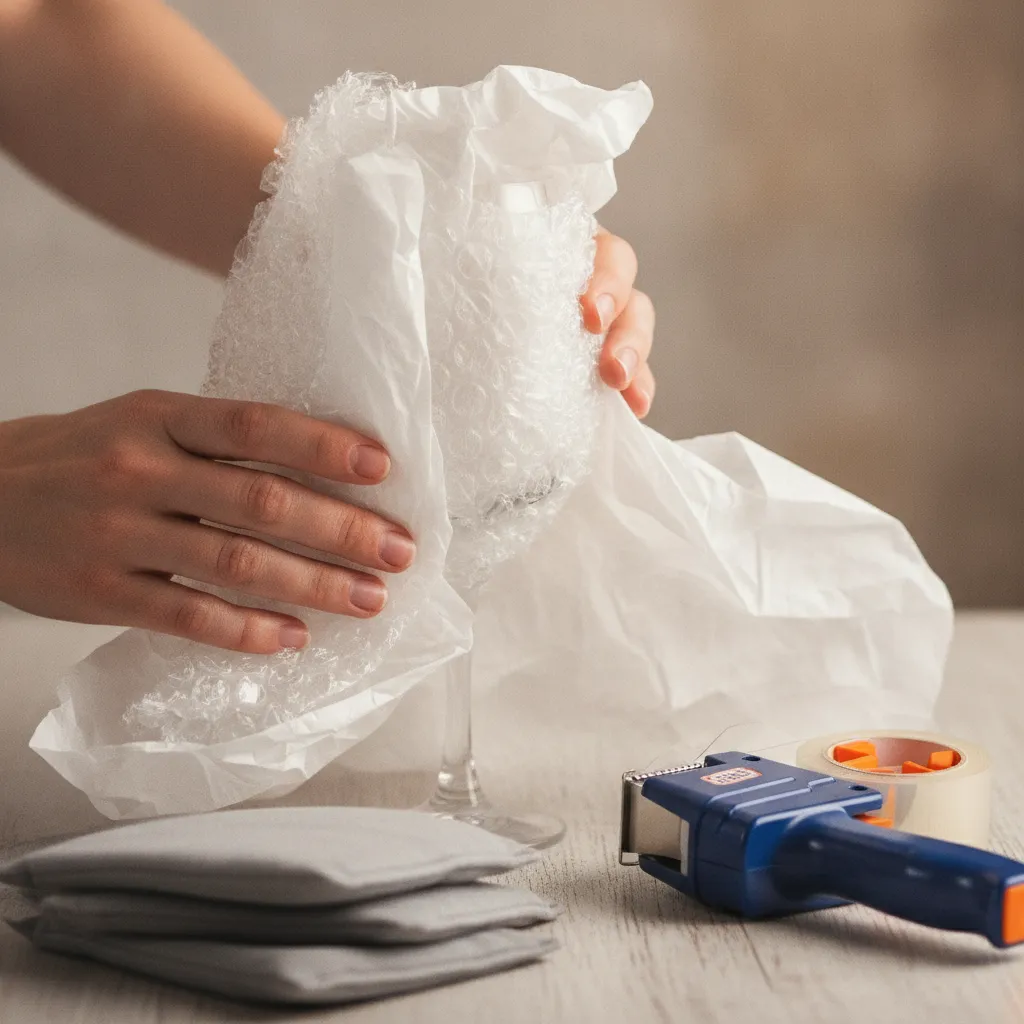
- Bubble wrap (small-cell and large-cell)
- Small-cell for glassware; large-cell for electronics and decor.
- Place bubbles inward for best surface contact.
- Furniture pads (moving blankets)
- Protect wood and painted finishes during carry and transport.
- Layer pads under straps to diffuse pressure points on edges.
- Stretch wrap (shrink wrap)
- Secures doors, drawers, and pad layers; adds moisture resistance.
- Avoid direct wrap on unfinished or oiled wood—pad first.
- Quality packing tape (and a tape gun)
- Hot-melt or acrylic tape reduces popped seams on heavy loads.
- Tape guns increase speed and reduce wrist strain on big pack-outs.
- Foam pouches and corner protectors
- Slip-on protection for dishes, frames, TVs, and mirrors.
- Pair with rigid TV/mirror cartons for flat, fragile items.
- Permanent markers and labels
- Write room + contents + priority; repeat on at least three sides.
- Use color coding to separate floors and speed hallway sorting.
Types of materials and how to choose them
Choose materials by weight, fragility, and finish: small boxes for heavy items, double-wall for fragile, paper for friction hold, bubble for shock absorption, and pads + stretch wrap for furniture. Match each room’s mix to reduce breakage while packing quickly.
Room-by-room recommendations
- Kitchen: Dish barrels, foam dividers, paper, small and medium boxes, H-tape sealing; label “FRAGILE” on two sides.
- Living room: TV/mirror cartons, corner protectors, furniture pads, and stretch wrap for sofas and tables.
- Bedrooms: Wardrobe boxes, mattress bags, large boxes for bedding, labels for each family member.
- Office: Small boxes for books, anti-static bubble for components, cable bags taped to the device.
- Garage: Small boxes for tools, heavy-duty tape, zip bags for hardware; keep liquids upright and sealed.
Finish-sensitive surfaces
- Use felt-sided pads and avoid direct stretch wrap on unfinished wood.
- Add foam sheets between painted surfaces and pads to prevent imprinting.
- Use moisture barriers for outdoor cushions and patio sets.
Need help choosing? Our residential movers can supply and stage materials so packing flows room to room without delays.
Best practices from EC Movers crews
Pack heavy items low and tight, fragile items on edge with void fill, and seal every seam. Pad furniture before wrapping, label all sides, keep an “open first” box per room, and photograph wires before disassembly. Bag all hardware and tape it to the matching piece.
Local considerations for Roseland
- Weekend moves near Captain J. Wilson Park can mean busier streets; pre-pack hallway-ready cartons to shorten carry distances.
- Humidity swings near Walker Square affect tape adhesion—press seams firmly and consider acrylic tape during peak summer.
- Condo moves: reserve elevators early and use wardrobe boxes as rolling closets to speed load-in.
- Label smart: Room + contents + priority (e.g., Kitchen – Pots – Open First) on three sides.
- Protect floors: Lay runners before the first box crosses the threshold; 20–30 feet usually covers main paths.
- Stack safely: Heaviest cartons at the base; keep stacks to shoulder height for control.
- Seal correctly: H-tape top and bottom; reinforce hand holes on heavy boxes.
- Electronics: Original boxes are best; otherwise, rigid TV/mirror cartons with corner guards.
For high-value items, we often prep a day ahead. See why in our brief primer on professional piano moving and our note on safe hot tub relocation.
Tools and resources (checklists + references)
Build a simple kit: three box sizes, dish barrels, wardrobes, paper, bubble, pads, stretch wrap, quality tape, labels, and a tape gun. Track materials with a printable checklist and number every box. Ask us for a quick materials consult so you order precisely what you need.
- Master packing checklist (request our printable version by email).
- Inventory template: box number, contents, condition photo, destination room.
- Room signs: color-code by floor for faster hallway sorting.
- Hardware bags: label and tape to the underside of furniture.
- Essentials tote: medicines, chargers, snacks, basic tools, first-night linens.
For general reference on supply types and packing technique, see these overviews from established providers. According to The UPS Store, core moving supplies include a range of cartons, cushioning, and sealing options. Their pack-like-a-pro tips reinforce using snug void fill and the H-tape method. A concise packing checklist can also help you sequence rooms efficiently.

Need a hand mid-pack? Our team can step in with partial packing, specialty-item prep (pianos, hot tubs, pool tables), and short-term storage coordination. Ask about a quick packing materials consult so you order exactly what your home needs—nothing more, nothing less.
Planning a longer route? Our long-distance movers can stage supplies and schedule stops so fragile boxes stay on top and secure.
Comparison: materials vs. use cases
Match materials to jobs: small boxes for heavy items, dish barrels for fragile kitchenware, bubble for shock absorption, paper for friction and void fill, pads for furniture finishes, and stretch wrap for securing components. This pairing speeds loading and reduces rework.
| Material | Best Use | Pros | Watch-outs |
|---|---|---|---|
| Small box | Books, tools, pantry cans | Controls weight, stacks neatly | Overloading strains seams |
| Dish barrel | Plates, bowls, glassware | Double-wall protection | Heavier—pack on edge |
| Wardrobe | Hanging clothes, drapes | Fast load/unload | Bulky in tight elevators |
| Packing paper | Cushioning, void fill | Flexible, recyclable | Needs volume for shock |
| Bubble wrap | Fragile decor, electronics | High shock absorption | Bulky; can trap moisture |
| Furniture pads | Wood, painted furniture | Scuff and impact protection | Must secure to prevent slip |
| Stretch wrap | Secure drawers/doors | Moisture and dust barrier | Avoid direct contact on raw wood |
| Quality tape | Seal seams, reinforce | Prevents blowouts | Cheap tape peels |
| Foam pouches/corners | Frames, mirrors, dishes | Fast protection | Pair with rigid box |
| Markers/labels | Room routing, notes | Speeds placement | Illegible = confusion |
Mini case studies from Windsor-Essex moves
Real moves prove the point: right-sized boxes, proper cushioning, and surface protection cut damages and time-on-site. These snapshots show how our materials system prevented scrapes, stabilized loads, and kept unpacking orderly.
- Two-bedroom apartment, Roseland: Client used dish barrels and wardrobes; zero glassware loss and a faster unload thanks to color-coded labels and “open first” boxes.
- Piano + living room set, South Windsor: Thick pads and corner guards prevented finish rubs on a tight stair turn; shrink wrap stabilized pad layers during a 20-minute carry.
- Hot tub relocation, county property: Moisture barrier and edge protection avoided foam skirt scuffs; a labeled hardware bag simplified reassembly.
- Office move, downtown: Small boxes for files and anti-static bubble for components kept weights safe; cable bags taped to devices cut reassembly time by roughly 20%.
We’ve found an “open first” box per room—tools, hardware, chargers, basic cleaners—makes the space usable the same day, even before full unpacking. For more on specialty protection, read why you should never move a piano yourself.
Frequently Asked Questions
Here are concise answers to the most common packing material questions we hear in Windsor-Essex. For unique items or tight timelines, request a quick consult from our team and we’ll tailor guidance to your home.
What size boxes should I use for books?
Use small moving boxes and keep the load compact. Reinforce the bottom with the H-tape method. Fill all voids with paper so books don’t shift and crush the sides during carry or transit.
Is bubble wrap or packing paper better for dishes?
Use both. Paper creates friction and fills gaps; small-cell bubble adds impact absorption. Pack dishes on edge in a dish barrel and fill every gap to prevent rattle.
How do I protect furniture finishes?
Wrap pieces in furniture pads and secure them with stretch wrap or tape. Add foam between pads and delicate or freshly finished surfaces. Avoid wrapping raw wood directly with plastic.
Do I need wardrobe boxes?
They’re the fastest way to move closets without folding or boxing hangers. They also protect drapes and long coats. If elevators are small, balance wardrobes with garment bags to save space.
Key takeaways
Choose the right-size boxes, cushion smartly, protect finishes, and label clearly. This basic kit saves time, prevents damage, and keeps move day calm—even with stairs or tight hallways common in Roseland homes.
- Small boxes for heavy items; double-wall for fragile zones.
- Paper for friction and void fill; bubble for shock absorption.
- Pads and stretch wrap guard furniture finishes and keep parts together.
- Labels and markers speed hallway sorting and room placement.
Conclusion
A focused set of packing materials for moving prevents common damage and speeds every step, from first seal to final placement. Build your kit around structure, cushioning, containment, sealing, and direction—then pack to the plan.
Packing is where most moves are won. With the right supplies, you protect your investment and reduce surprises on the big day. If you’d like a speedy materials consult—or help with specialty prep like pianos, hot tubs, or pool tables—our insured, WSIB-certified crews are ready.
Ready to simplify your Roseland move? Start with a quick chat about materials and timing, or explore how our Windsor moving team manages door-to-door logistics.
Ready to move?
Get your free quote from EC Movers today.